MiniMax H3 · Character Motion Transfer
Upload a character image and a driving video. MiniMax H3 maps the motion onto the character and returns a new video with AI-generated stereo audio.
character motion transfer
hailuo3
image to video
minimax h3
video generation
83

Nodes & Models
PrimitiveInt
UNETLoader
minimax_h3_ref2va_pruned_int8_convrot.safetensors
KSamplerSelect
CLIPLoader
qwen3vl_32b_minimax_h3_nvfp4_awq.safetensors
RandomNoise
PrimitiveStringMultiline
VAELoader
minimax_h3_video_vae_fp16.safetensors
minimax_h3_audio_vae_fp32.safetensors
BasicScheduler
PrimitiveBoolean
BasicGuider
LoraLoaderModelOnly
minimax_h3_ref2v_turbo_4step_v0.1_comfyui_bf16.safetensors
SamplerCustomAdvanced
ComfySwitchNode
MiniMaxH3ReferenceToVideo
LoadImage
VAEDecode
VAEDecodeAudio
ComfyMathExpression
ImageStitch
CreateVideo
SaveVideo
VHS_LoadVideo
VHS_VideoCombine
ABOUT THE WORKFLOW
Transfer Motion Onto a Character
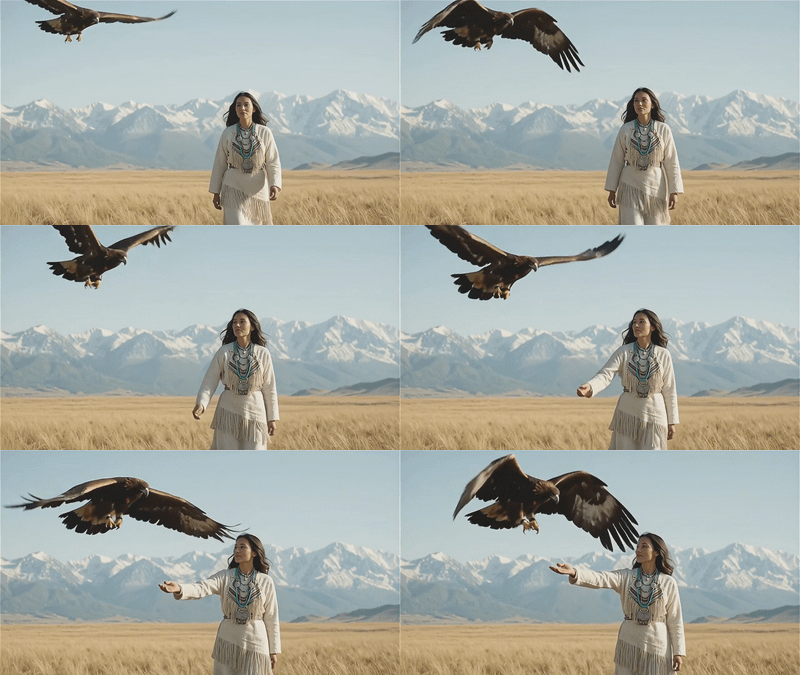
Upload a character image and a driving video. Write a prompt describing the scene. The model maps the motion from the driving video onto the character, preserving the character's face, outfit, and proportions while following the driving clip's movement beat for beat. You get a video with synchronized stereo audio, plus a side-by-side comparison of the driving video and the output.
Model
MiniMax H3 by MiniMax (also known as Hailuo 3.0). An open-weight omni-modal video model that generates video with synchronized stereo audio from images, text, or reference video. Strong at preserving character identity across motion transfer.
Turbo LoRA (optional). Cuts generation from 20 steps to 4 for faster output at slightly lower quality.
HOW IT WORKS
Step 1. Upload a character image
The person or character whose appearance you want in the output video. A clear, well-lit photo with visible face and full outfit works best.
Works great with: portraits · full-body shots · illustrated characters · cosplay photos
Step 2. Upload a driving video
The video whose motion the character will follow. Clip length sets the output length, up to 15 seconds at 24 fps (360 frames max).
Works great with: dance clips · walk cycles · gestures · action sequences
Step 3. Write a prompt
Describe the scene, the motion, and how the character should appear. Be specific about actions and camera angles. "Transfer the dance onto the character in a softly lit studio, steady camera" is better than "make them dance."
Step 4. Hit run and download
The model generates a video with stereo audio, plus a side-by-side comparison so you can check the motion transfer against the original driving clip.
Ready for: Premiere Pro · DaVinci Resolve · After Effects · any video editor
First time? Leave every setting as-is. The defaults (1280×720 · 20 steps · Turbo off) are the right starting point for almost everyone.
RECOMMENDED SETTINGS
Quick-start guide. Find the goal that matches yours and copy the settings.
Standard motion transfer (most people) — 1280×720 · 20 steps · Turbo off · random seed. The right starting point for almost everyone.
Quick preview or test — Turn Turbo LoRA on. Cuts steps from 20 to 4. Faster output, slightly softer quality. Good for checking whether the motion lands before committing to a full run.
Higher resolution output — Raise width and height (must be multiples of 32). More pixels, longer generation time. Match the aspect ratio to your driving video for clean results.
Portrait / vertical video — Set width to 720, height to 1280 (or similar vertical ratio). Match the orientation of your driving clip.
Reproduce a result you liked — Lock the seed to the value from that run. Same inputs and seed give the same output.
Motion is not matching the driving clip — Keep the prompt focused on describing what moves and how. Mention the driving video's camera framing. Avoid adding unrelated scene details that pull the model away from the reference motion.
Prompt: Describe the motion, the scene, and camera framing. Reference the character and driving video by their placeholder names (Subject 1, Picture 1, Video 1) if you want precise control. "Transfer the walking motion onto the character in a clean studio, steady camera following the framing of the driving clip" is better than "person walking."
LEARN
📹 Videos
ComfyUI 101 Free Course ft. Sebastian Kamph
Floyo 101 for Team Collaboration
✨ Quick links
USE CASES
🎬 Content Creators
Put yourself or a character into a dance, a sketch, or a trending clip without reshooting. Upload a photo, drop in the reference video, and get a motion-matched result with audio.
🎮 Game & VFX Artists
Generate character animation tests from a single reference image. Block out motion before committing to a full mocap or keyframe pass.
🎨 Concept Artists & Previsualization
Animate a character design to pitch movement and staging. Turn a static concept into a moving scene to show a director or client.
🥽 Virtual Production & Digital Doubles
Transfer a real performance onto an illustrated or CG character for previsualization, social content, or experimental short films.
WHAT WORKS BEST / WHAT TO AVOID
✅ Works great
Clear, well-lit character photos with visible face and outfit
Driving videos with distinct, readable motion (dance, walk, gesture)
Matching aspect ratio between driving video and output resolution
Prompts that describe motion, scene, and camera framing specifically
⚠️ May produce softer results
Low-resolution or blurry character images
Driving videos with fast cuts or camera shake
Mismatched aspect ratios between driving video and output
Overly long or vague prompts that conflict with the driving motion
FAQ
What is MiniMax H3 and what can it do?
MiniMax H3 (also known as Hailuo 3.0) is an omni-modal video generation model by MiniMax. It generates video with synchronized stereo audio from text, images, or reference video. This workflow uses its reference-to-video pipeline to transfer motion from a driving clip onto a character image.
How does character motion transfer work with MiniMax H3?
You upload a character image and a driving video. The model reads the motion, timing, and camera framing from the driving video and applies it to the character from your image, preserving the character's face, hair, outfit, and proportions. The output is a new video where the character performs the driving clip's movements with AI-generated stereo audio.
Does MiniMax H3 generate audio with the video?
Yes. MiniMax H3 generates native stereo audio synchronized to the video. The audio is produced by the model, not extracted from the driving video. Expect ambient room tone and movement sounds rather than speech or music.
What resolution and length does MiniMax H3 support?
Up to 2K resolution at 24 fps, with video duration between 4 and 15 seconds. The output length is set by the driving video's frame count, capped at 360 frames. Width and height must be multiples of 32.
What does the Turbo LoRA do and when should I use it?
The Turbo LoRA is a distilled version of the model that cuts generation from 20 steps to 4. It produces results faster at slightly lower quality. Use it for previews and tests. Turn it off for final output.
Is MiniMax H3 open source and can I use the output commercially?
MiniMax H3 is released under the MiniMax H3 Community License with open weights. Review the license terms for your specific use case before shipping commercially. All models in this workflow run locally through native ComfyUI nodes with no API keys or per-run fees.
How to run MiniMax H3 motion transfer online?
You can run MiniMax H3 motion transfer online through Floyo. No installation, no setup, no API key to wire up. Open the workflow in your browser, upload your inputs, and hit run. Free to try.
WHY FLOYO?
Floyo is the only platform with team collaboration for ComfyUI in the browser. You run workflows with no install. You share run history, assets, and models across your team. You pay only when you generate. Floyo supports open-source and closed-source models.
A designer runs an edit and likes the result. A teammate opens that exact run from shared history and keeps going. No file handoffs. No version confusion.
For studios and enterprise teams, Floyo adds private workspaces, pooled resources, and a team usage dashboard. Other ComfyUI cloud tools run for one person at a time. Floyo runs for the whole team, with transparent per-generation costs.
Ready to try it?
Upload a character image, drop in a driving video, and run it. The prompt and settings are already set.
Questions? Watch the free course or check the FAQ above.
Read more