



COMMUNITY PAGE
Open Source AI Inside FIT's DTech Lab
Floyo ran AI workshops at the Fashion Institute of Technology, working with faculty and students to explore how open source tools like ComfyUI reshape the way fashion gets designed.
|
Organization
Fashion Institute of Technology, DTech Lab
|
Sector
Higher education, fashion and design
|
|
Location
New York City
|
On Floyo
Cloud ComfyUI for a live faculty and student workshop
|
Blending AI and creativity at FIT
Floyo hosted an AI workshop at the Fashion Institute of Technology in New York City. Together with faculty and students, we explored how AI changes the work of fashion design, using open source tools like ComfyUI to rethink the design process from the ground up.
Special thanks to Michael Ferraro, Executive Director of the DTech Lab, whose leadership and insight shaped the whole event. He brought decades of experience in innovation and technology into the room, and was the clear star of the show.

"Technology should augment creativity and productivity, not replace it."
Michael Ferraro, Executive Director, FIT DTech Lab
The vision behind the workshop
This was more than a workshop. It was a meeting point of creativity, technology, and education.
Floyo exists to give creatives and educators access to powerful AI tools without the infrastructure tax that usually comes with them. FIT, with its renowned fashion and design programs, was the right place to test what that access actually unlocks.
His emphasis on balancing traditional tools with new technologies set the tone for everything that followed: forward-thinking, collaborative, and unwilling to treat AI as a replacement for craft.

The role of DTech Lab in bridging academia and industry
As Michael highlighted in his talk, the DTech Lab occupies a specific and unusual position. It is a bridge between academia and industry. Unlike a traditional academic unit, it is built for dialogue and experimentation, which gives students and faculty room to engage deeply with cutting-edge technology before it has settled into a curriculum.
His framing of the "dynamic relationship between traditional tools and new tools" resonated throughout the workshop. From line drawing to AI-generated design, the day celebrated the coexistence of time-tested creative methods and innovative AI solutions, rather than staging a contest between them.
Open source meets academia

One of the highlights was demonstrating ComfyUI, an open source tool that offers a level of flexibility and power for AI-driven creativity that closed products do not. Bringing it to FIT was a way of showing how open source breaks down barriers, letting students and faculty experiment and innovate freely.
Open source and academia are a match made in heaven. Both are built on exploration, and open source provides access to tools that are often cost-prohibitive.
Running it on Floyo removed the other barrier. Every participant opened ComfyUI in a browser tab and started building, with no installs, no hardware check, and no difference between the machine a student brought and the one sitting next to them.

Reflections on the experience
Building Floyo has been a journey filled with challenges and rewards. Collaborating with FIT was a reminder of why we do it: to educate, to inspire, and to provide access to the most flexible AI tools available. Seeing the excitement and curiosity in the FIT community reaffirmed our purpose.
The workshop was not only about teaching AI. It was about sparking a dialogue. Faculty and students engaged in thoughtful conversation about both the possibilities and the limitations of AI in creative fields, and pushed on where it helps a design process and where it flattens one.
That is the useful part. Innovation thrives when diverse perspectives come together, and this room had plenty of them.
We continue to hold workshops virtually.
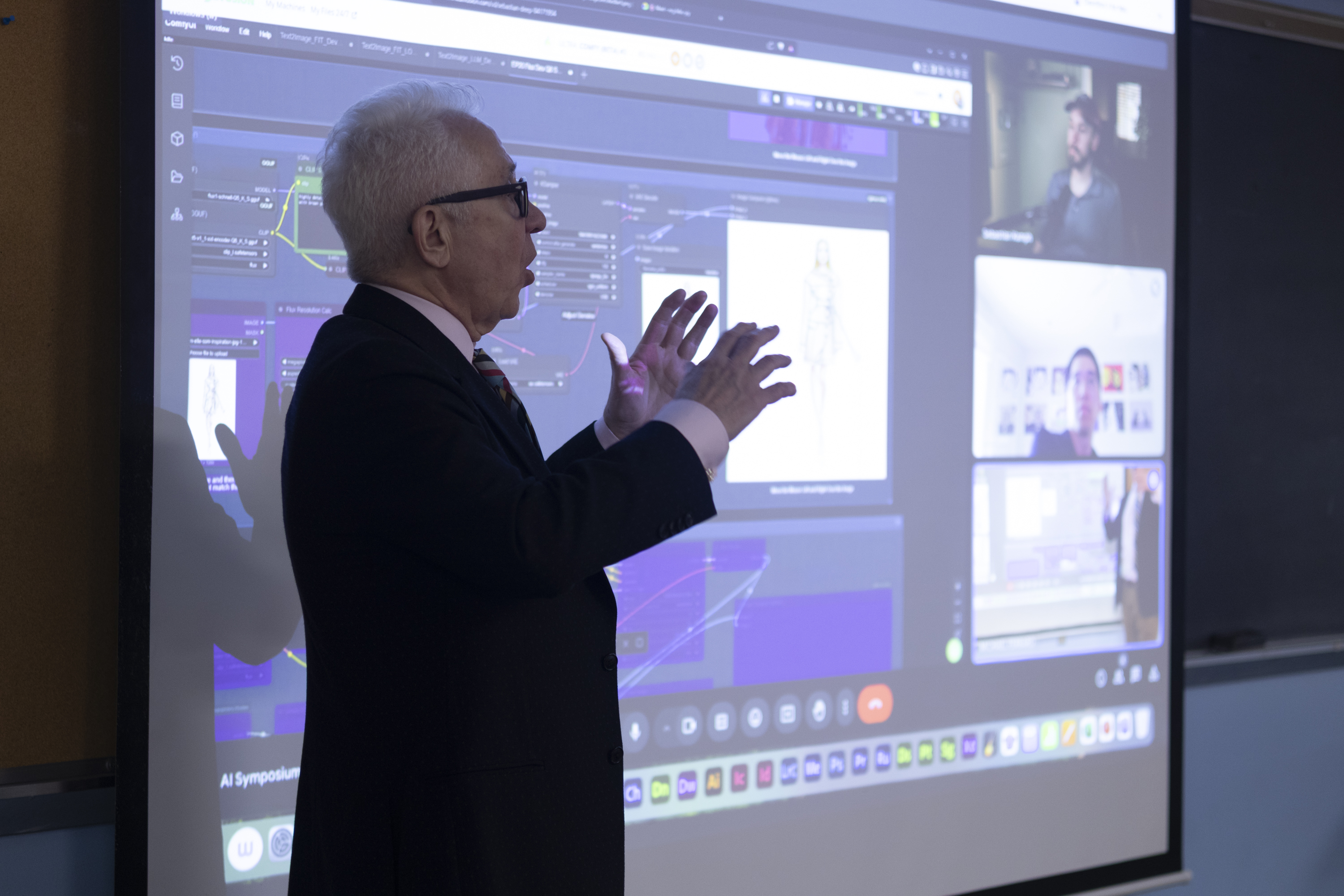
Run your team's or classes' workflows on Floyo.
Browser-based ComfyUI in a shared, governed workspace. No machine setup, no idle costs.
Together with faculty and students at the Fashion Institute of Technology in New York City, we explored how AI changes the work of fashion design, using open source tools like ComfyUI to rethink the design process from the ground up.